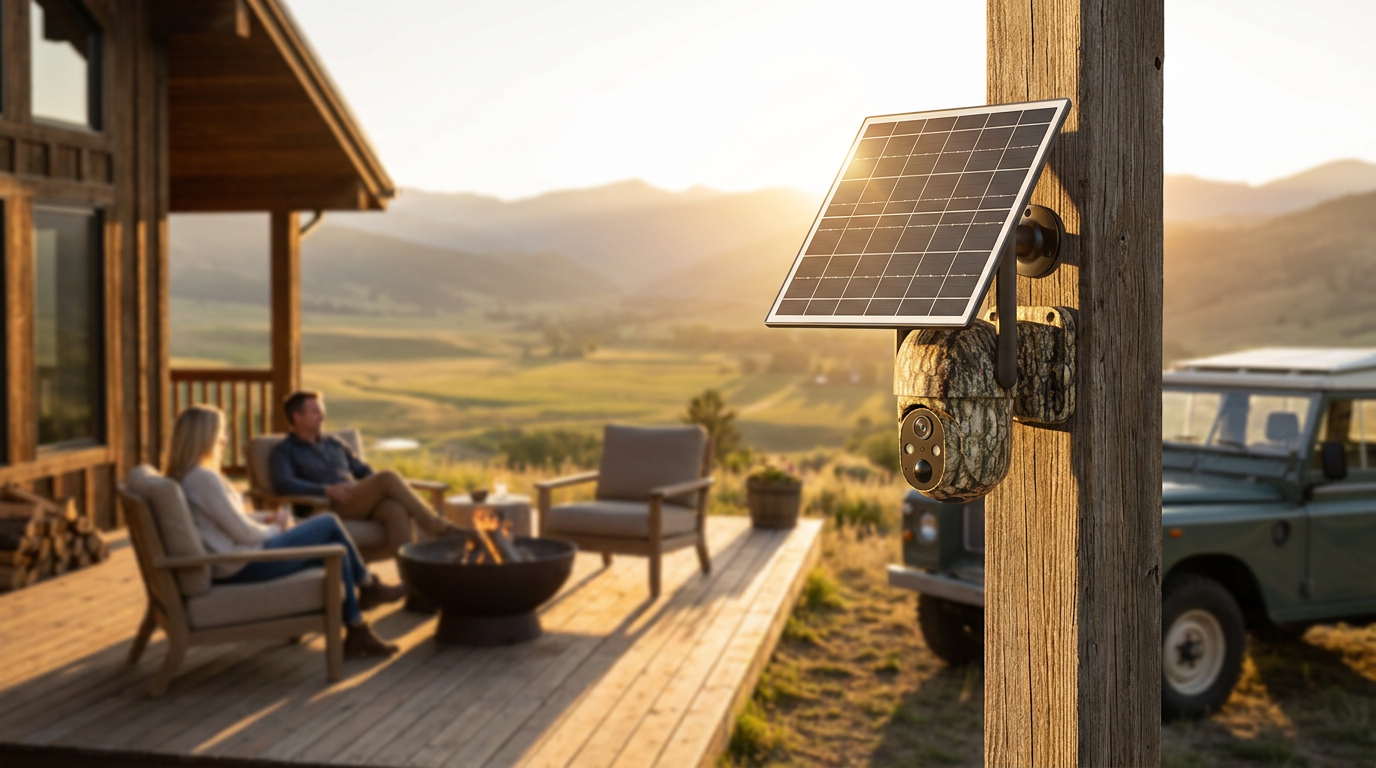
Solar Watch Cam 4G Tech Challenges WiFi Security Norms
 Maya ChenContributing Editor
July 23, 2026 — The conventional wisdom says that a robust security network requires a high-bandwidth WiFi infrastructure to be effective. However, emerging data suggests that relying on local wireless networks for remote property protection is not only technically inefficient but potentially a privacy liability. Solar Watch Cam’s 4G LTE integration provides a direct cellular alternative that bypasses the vulnerabilities inherent in traditional router-based systems.
Here's the part nobody talks about: WiFi is increasingly being weaponized as a tracking tool. According to research from the Karlsruhe Institute of Technology, ordinary WiFi signals can be used to identify individuals with up to 99.5% accuracy by analyzing signal disturbances, even if the person isn't carrying a device. By removing the WiFi radio entirely, the Solar Watch Cam 4G Solar Camera eliminates this specific vector of passive surveillance. For owners of US ranches and job sites, the shift to 4G isn't just about convenience; it’s about air-gapping your physical security from the local network's data footprint.
Photo by Reinis Brūzītis on Pexels
Run the math: A standard WiFi camera requires a constant 2.4GHz or 5GHz signal that rarely extends beyond 150 feet without expensive repeaters. The Solar Watch Cam 4G model utilizes Verizon, T-Mobile, and AT&T networks to maintain a 2K HD uplink in environments where WiFi cannot reach. While critics point to data costs, the system includes a 7-day free trial and supports a 128GB local SD card, allowing users to avoid cloud fees entirely after the first 30 days. This is central to our commitment to reliable security at Solar Watch Cam, focusing on hardware that functions in the -4°F to 122°F range rather than fragile consumer-grade routers.
Expert tip: When deploying 4G cameras on remote acreage, prioritize placement near the property perimeter rather than the main house. Since these units do not require a central hub, you can maximize the AI-driven person and vehicle detection at the earliest point of entry, utilizing the built-in 360-degree view to cover blind spots that fixed WiFi units often miss.
I’ll change my mind when WiFi mesh networks can demonstrate 99.9% uptime in rural zones without the 99.5% tracking vulnerability identified by SciTechDaily researchers. Until then, the cellular-solar hybrid remains the only logical choice for high-stakes remote monitoring.