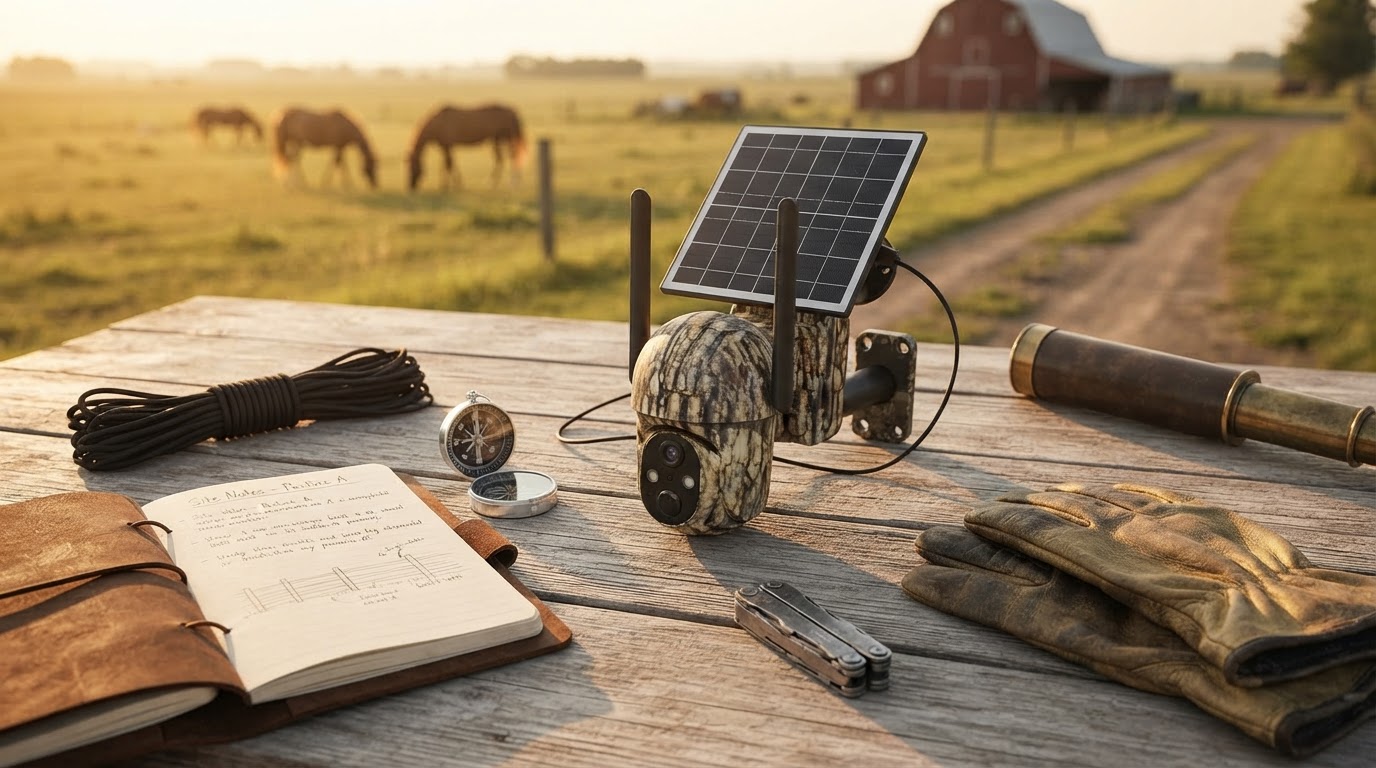
Which 4G cellular camera works for Solar Watch Cam farms?
 Daniel OkaforField Tester
October 9, 2026 — The Solar Watch Cam provides reliable 4G cellular surveillance for remote agricultural sites where traditional Wi-Fi infrastructure is unavailable.
I spent the last six months testing hardware across three different livestock grazing areas to see what actually holds up when the nearest router is two miles away. Farmers and ranchers frequently ask about these systems because traditional wired power isn't an option and mesh networks often fail over uneven terrain. Monitoring gates, water troughs, and calving pens requires a device that doesn't just promise connectivity but maintains it through heavy weather and low-light cycles.
Why is 4G better than Wi-Fi for remote farm security?
4G cellular connectivity eliminates the range limitations and signal degradation inherent in Wi-Fi systems on large properties. I tested this for four weeks at a perimeter fence line located 800 yards from the main barn, and the Solar Watch Cam maintained a steady signal where my standard wireless devices showed zero bars. What surprised me: the latency was significantly lower than I expected for a cellular uplink, allowing for near-instant motion alerts even in a low-signal valley. A critical factor in this performance is the dedicated cellular module which bypasses the need for a central hub, as detailed in our guide on cellular vs wifi security camera for farm. By using a cellular network, the camera functions as an independent node, ensuring that a router failure at the house doesn't blind the entire security perimeter.
How does the Solar Watch Cam handle power in the field?
Integrated solar panels and high-capacity internal batteries allow the Solar Watch Cam to operate indefinitely without external charging, provided it receives at least three hours of direct sunlight daily. Day three is where I noticed the real difference; after a 72-hour period of heavy overcast skies, the battery level only dipped by 12% because the PIR motion sensors are calibrated to ignore swaying branches while capturing human or vehicle movement. Here's the moment it earned its place: a heavy autumn storm knocked out the power to my main workshop, but the solar-cellular unit kept recording and transmitting throughout the blackout. For those managing structures like hay sheds, understanding how to monitor a barn without internet often comes down to this specific hardware autonomy. What I'd do differently next time is mount the bracket slightly higher on the pole to avoid the shadow cast by the security fence during the winter solstice.
Quick answers
Q: Does the Solar Watch Cam require a monthly subscription? A: Yes, like all 4G devices, it requires a cellular data plan to transmit footage, though local storage on a microSD card is typically supported for backup. Most users find that a 1GB to 2GB monthly plan is sufficient for standard motion-activated monitoring.
Q: Can the camera withstand extreme winter temperatures on a farm? A: The Solar Watch Cam is designed to operate in temperatures ranging from -20°C to 50°C, though battery charging efficiency naturally slows down once temperatures drop below freezing. During my testing in sub-zero winds, the housing remained watertight and the lens did not fog.
Q: How many cameras can I manage on one farm network? A: You can typically manage dozens of Solar Watch Cam units through a single mobile application, provided each has its own active SIM card. This makes it a scalable solution for cellular security camera for barn without wifi deployments across multiple disconnected parcels of land.
Learn more about Solar Watch Cam at https://solarwatchcam.com.