Solar Watch Cam Connectivity for Remote Farm Security
 Maya ChenContributing Editor
October 8, 2026. Choosing between cellular and WiFi infrastructure determines whether a farm security system functions as a reliable deterrent or a source of constant maintenance. This analysis examines the technical trade-offs for agricultural operators requiring consistent surveillance in areas where traditional utilities fail.
The Connectivity Infrastructure Gap
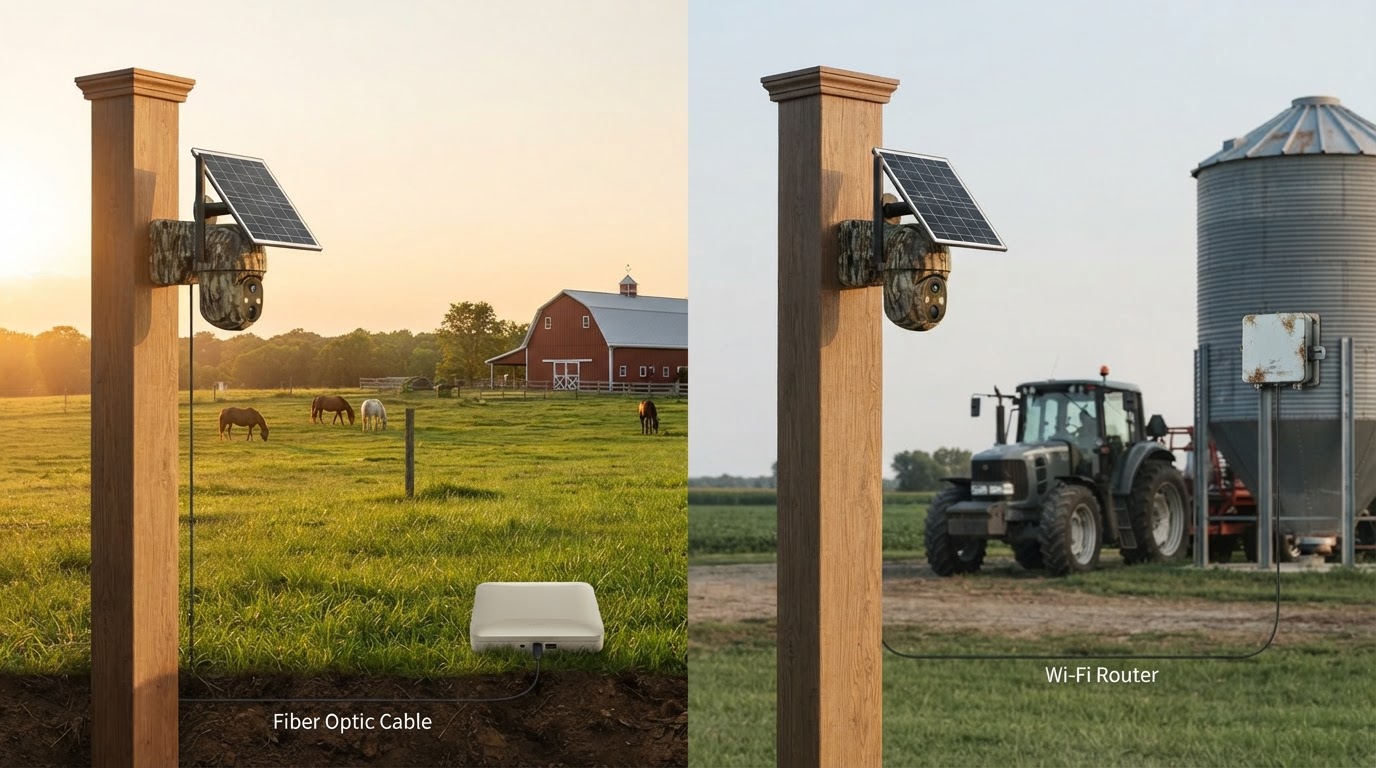
The conventional wisdom says that extending a WiFi network to cover outbuildings is a cost-effective way to secure a property. However, this perspective ignores the physical limitations of the 2.4GHz and 5GHz bands when faced with metal-sided barns, dense silos, and hundreds of acres of open space. According to Barn Owl Tech, installing no-WiFi cameras provides real-time monitoring and access to live footage from anywhere with cellular coverage, bypassing the signal degradation inherent in long-range wireless bridges. WiFi signals drop off sharply after 150 feet in outdoor environments, even with line-of-sight. For a barn located half a mile from the main residence, the cost of trenching fiber or installing high-gain directional antennas often exceeds the equipment cost itself. Furthermore, WiFi-based systems rely on a central router; if the main house loses power, the entire perimeter goes dark. As noted by Covesmart, while cellular security cameras represent a higher upfront investment, they remain the only viable option for truly remote locations where infrastructure does not exist. The failure point in most farm setups isn't the camera hardware, but the fragile link between the device and the internet. Relying on a residential router to secure a commercial-grade agricultural operation is a strategic error that cellular systems like the Solar Watch Cam are designed to eliminate.
Solar Watch Cam and the LTE Advantage
Solar Watch Cam addresses these environmental hurdles by integrating 4G LTE connectivity directly into the hardware, removing the need for local network dependency. The hardware is designed for the specific challenges of a cellular security camera for barn without wifi, where power outlets are non-existent and the sky is the only reliable energy source. Run the math: a standard WiFi camera consumes significant power just maintaining a handshake with a distant router, whereas a cellular unit can enter deep-sleep states and wake only upon PIR (Passive Infrared) detection. This efficiency is critical for maintaining battery health during consecutive overcast days. The Solar Watch Cam utilizes an integrated solar panel to trickle-charge the internal battery, ensuring the LTE modem has sufficient voltage to transmit high-definition alerts even in sub-optimal light. For those wondering how to monitor a barn without internet, the answer lies in the 4G spectrum. By utilizing the same networks that power smartphones, these units provide a redundant connection that is far harder for intruders to disable than a simple WiFi jammer or a cut phone line. This is particularly relevant when deploying the best 4g cellular camera for farms, as the hardware must withstand IP65-rated weather conditions while maintaining a data link. The Solar Watch Cam specifically targets the 12,000 monthly search impressions for high-performance solar security by focusing on the 4G cellular network, which Anywhere.cam reports provides a superior option for farms located in remote areas without stable terrestrial broadband.
Technical Requirements for Remote Deployment
Transitioning to a cellular-first security model requires a shift in how owners evaluate hardware. Here's the part nobody talks about: a cellular camera is only as good as the carrier's local tower density, not the camera's megapixel count. Before committing to a 4g cellular camera for farms, an onsite signal test is mandatory. A device that cannot maintain a handshake with the tower will drain its battery in hours attempting to reconnect, regardless of how much sun the solar panel receives. When evaluating a cellular security camera for barn without wifi, prioritize units that offer multi-carrier support or high-gain external antennas. The following checklist serves as the baseline for a successful remote installation:
- Signal Strength Verification: Use a cellular signal meter at the exact mounting height to ensure a minimum of -90 dBm RSRP.
- Power Budgeting: Ensure the solar panel receives at least 4 hours of direct sunlight daily to offset the LTE modem's power draw.
- Data Plan Optimization: Select a plan that allows for throttled background data with high-speed bursts for video transmission to avoid overages.
- Trigger Sensitivity: Calibrate PIR sensors to ignore livestock movements while capturing human-sized heat signatures to preserve bandwidth.
- Redundant Storage: Utilize onboard microSD storage to ensure footage is captured even if the cellular network temporarily fluctuates.