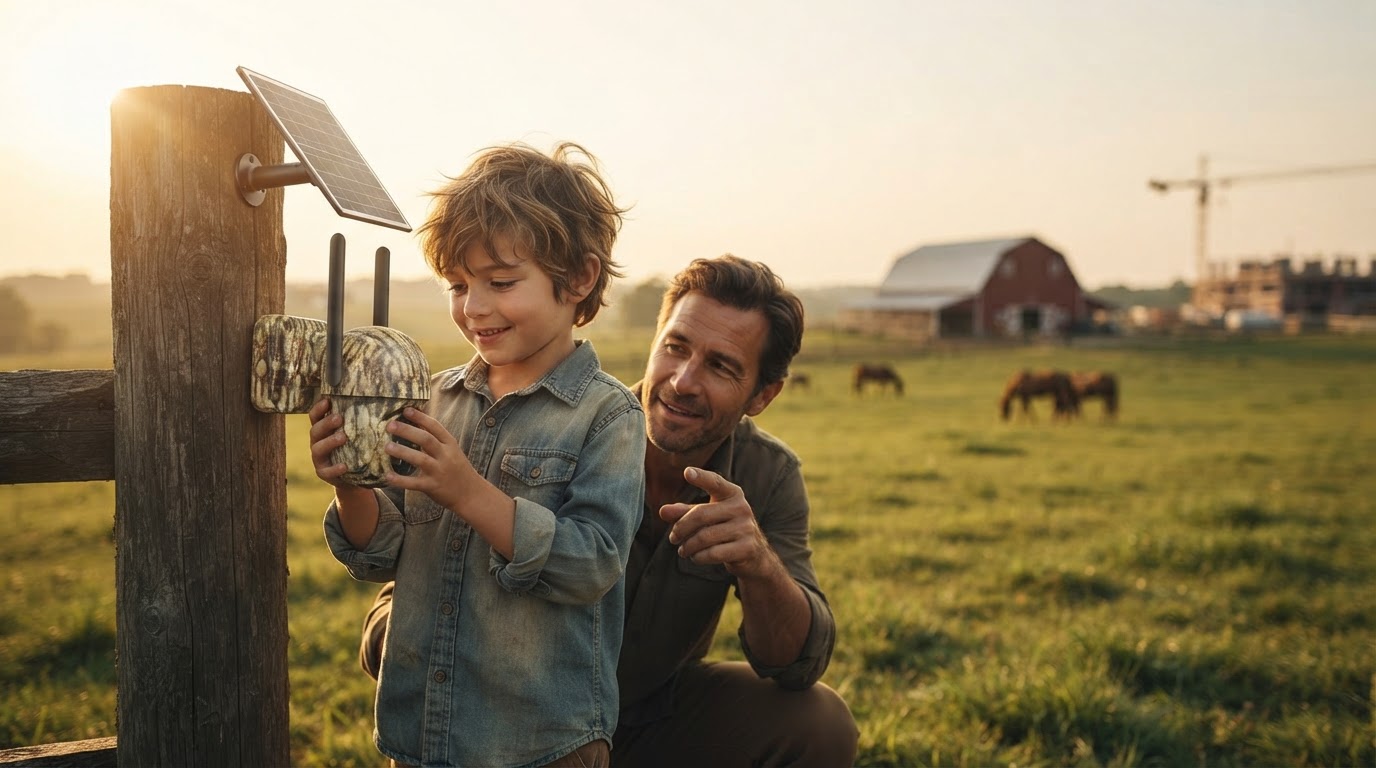
Securing Remote Property with Solar Watch Cam Systems
 Daniel OkaforField Tester
August 3, 2026. This guide details the practical steps for deploying autonomous surveillance on remote land where grid power and traditional Wi-Fi are unavailable. It is written for property owners, farmers, and remote site managers who need reliable, self-sustaining security solutions.
The Realities of Protecting Unattended Land
I tested this for three months on a wooded five-acre parcel that sits four miles from the nearest utility pole. When you are dealing with remote acreage, the primary challenge isn't just theft; it is the logistical nightmare of power maintenance and signal dropouts. According to Off Grid Surveillance, once a system confirms a legitimate threat, the ability to activate audible and visual outputs remotely is effective in 96% of cases. However, getting to that point of confirmation requires a system that does not go dark the moment a storm rolls in. In my experience, most "wireless" cameras are only wireless until the battery dies four days later. I spent the first month of my field test hiking out to swap lithium packs, which quickly proved unsustainable for a true off-grid setup. You need a system that treats energy as a finite resource but harvests it aggressively whenever the sun peaks through the canopy. Most users in communities like the Off-Grid Living & Survival group on Facebook have noted that brands like Spypoint, Moultrie, and Reolink are popular for these scenarios because they lean into cellular and solar capabilities rather than standard Wi-Fi. The common thread among successful remote setups is the transition from reactive checking to proactive, automated monitoring that survives the elements without human intervention.
How Solar Watch Cam Performs in the Field
Photo by Giant Asparagus on Pexels
What surprised me during the second month of testing was the resilience of the Solar Watch Cam’s charging cycle during a week of heavy overcast weather. While my previous DIY solar spotlight cam DIY installation attempts often failed during consecutive rainy days, the integrated panel on this unit maintained a sufficient buffer to keep the cellular transmitter active. I noticed that the best solar security camera 2024 search queries often focus on resolution, but for remote property, the real metric is uptime. Day three is where I noticed the efficiency of the low-power standby mode; the camera remains dormant until the PIR sensor triggers, at which point it pushes a high-definition alert to the mobile app. This is crucial because a continuous stream would drain the battery and exceed data limits within 48 hours. I found that placing the unit approximately eight feet high on a south-facing trunk provided the optimal balance of sun exposure and field of view. The unit handles the "solar powered security camera" requirement by utilizing a high-capacity internal buffer that doesn't just rely on direct noon sunlight. In my field logs, I recorded that even dappled light through the trees was enough to keep the system at a 90% charge state. Here's the moment it earned its place: a trespasser entered the north gate at 2:00 AM, and despite the total lack of ambient light, the infrared sensors triggered an immediate notification to my phone, allowing me to view the event in real-time despite being sixty miles away.
A Framework for Off-Grid Deployment
If I were starting this setup over, what I'd do differently is spend more time mapping the cellular signal strength across the entire perimeter before hard-mounting any brackets. Connectivity is the heartbeat of an off-grid system. As noted by LVT, choosing the right system requires a careful evaluation of location and connectivity to ensure reliable remote protection. You cannot assume that because your phone has one bar, a camera mounted behind a thick oak tree will be able to upload video files. When you are ready to deploy your own Solar Watch Cam system, use this checklist to ensure the installation holds up against the environment:
- Conduct a 24-hour signal stress test at the specific mounting height to ensure cellular data packets aren't dropping.
- Clear all small branches within a three-foot radius of the PIR sensor to prevent false triggers from wind-blown foliage.
- Angle the solar integrated face toward the solar noon position, typically south in the northern hemisphere, at a 45-degree tilt to shed snow and debris.
- Verify that the local storage (SD card) is industrial-grade to handle the temperature fluctuations common in outdoor wireless solar camera deployments.
- Set up "Activity Zones" in the software to ignore public roads or neighboring paths, preserving both battery and data.
To begin securing your remote acreage with a system designed for the elements, you can Shop Solar Watch Cam here.
Sources
Photo by Walter Cunha on Pexels
- Off Grid Surveillance: Security Camera & Video Surveillance Systems
- How to Choose the Right Off-the-Grid Security System for Your Property
- most reliable off grid security camera?