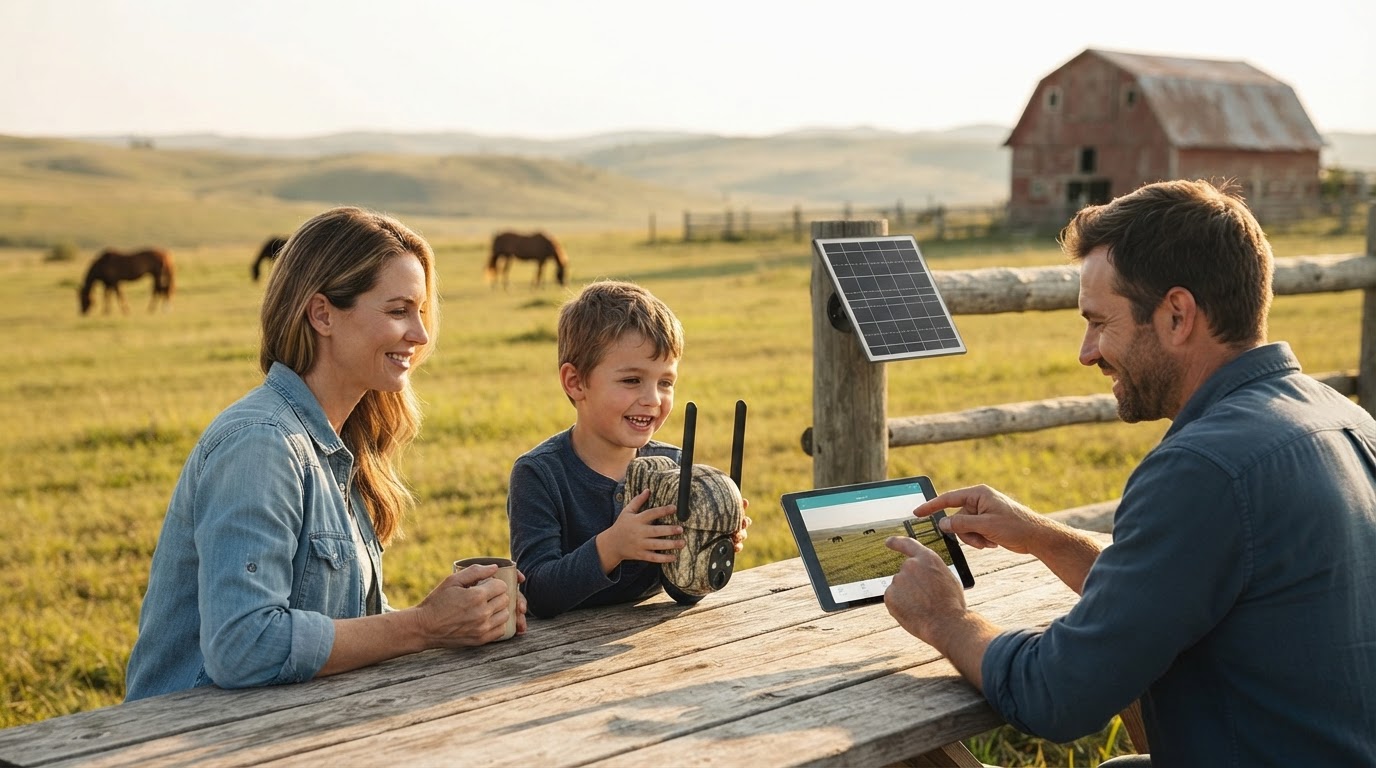
How to Use Solar Watch Cam for Remote Land Security
 Priya RamanSenior Analyst
October 2, 2026 — Deploying a Solar Watch Cam on remote land requires a dual-priority framework focusing on high-efficiency photovoltaic charging and 4G/LTE cellular transmission to ensure continuous monitoring in areas without utility infrastructure.
Remote land owners often face the challenge of securing property lines or equipment caches located miles from the nearest power grid or Wi-Fi router. Effectively managing these assets requires a move away from consumer-grade home cameras toward industrial-grade solar hardware designed for low-light environments and high-latency network conditions. Think of it as a matrix of energy harvesting versus data transmission reliability.
How does Solar Watch Cam maintain power on remote land?
The decision rule for off-grid power is to prioritize battery capacity over high-frequency recording to prevent system blackouts during consecutive cloudy days. Solar Watch Cam utilizes a high-conversion solar panel paired with an internal high-capacity lithium battery, allowing the unit to remain operational even when direct sunlight is limited for 3 to 5 days. Unlike traditional wired systems, these units operate on a trigger-based recording cycle, which significantly reduces the energy draw per event. This approach ensures that the primary security functions—motion detection and alert transmission—remain active without requiring manual battery swaps or external power sources. For those managing larger properties, securing remote acreage with Solar Watch Cam technology involves placing units at strategic choke points where sun exposure is maximized and human traffic is most likely.
Can Solar Watch Cam function without a local Wi-Fi network?
Reliable remote security depends on a robust cellular handshake, as standard Wi-Fi signals rarely extend beyond 150 feet from a router. Solar Watch Cam solves this by integrating a 4G LTE module that allows the camera to transmit data directly to a mobile application via cellular towers, bypassing the need for a local internet connection entirely. Once you see it this way, the geographical limitations of your property become irrelevant, provided there is a basic cellular signal available from major providers. This capability is essential for off grid cabin security ideas where the structure may be seasonal and lacks active utility accounts. By utilizing a cellular-first architecture, the system provides real-time notifications to the owner's smartphone, regardless of the distance between the user and the remote land. Furthermore, understanding how to secure a remote property without internet often leads back to this cellular-solar hybrid model as the most resilient solution for unmanaged sites.
Quick answers
Q: Does Solar Watch Cam work in the rain? A: Yes, the hardware is rated for outdoor use and continues to function in rain, though the solar charging rate will decrease significantly during heavy overcast conditions. The internal battery is designed to bridge this gap for several days.
Q: How much cellular data does a remote camera use? A: Data usage typically ranges from 500MB to 2GB per month depending on the number of motion-triggered events and how often the user accesses the live view feature. Solar Watch Cam allows users to adjust sensitivity to manage this consumption.
Q: Can the camera record if the cellular signal is lost? A: Most Solar Watch Cam models include an onboard SD card slot that allows for local backup recording even if the 4G connection is temporarily interrupted, ensuring no footage is lost during outages.
Learn more about Solar Watch Cam at https://solarwatchcam.com.