Securing Remote Acreage With Solar Watch Cam Technology
 Daniel OkaforField Tester
October 1, 2026. This field report evaluates the deployment of autonomous surveillance systems on undeveloped land. It is written for property owners who need to maintain visibility in locations where traditional power and networking do not exist.
The Realities of Unmonitored Remote Land
I spent six months testing hardware on a forty-acre plot that sits three miles from the nearest paved road. When you are dealing with that kind of isolation, the standard residential security advice falls apart. Traditional cameras rely on a steady stream of 120V power and a robust Wi-Fi signal, neither of which are available in a clearing surrounded by dense timber. The primary challenge isn't just theft; it is the environmental toll on the hardware and the logistical nightmare of battery swaps. During my first month, I used a standard battery-powered unit, and day three is where I noticed the fatal flaw: high-traffic areas, like a driveway entrance, drain a standard lithium-ion pack in less than 72 hours if the PIR sensor is active. Without a constant trickle charge, you are essentially left with a plastic paperweight. This is why off grid security camera ideas for remote land must prioritize energy harvesting over raw battery capacity. The risk of leaving a property dark for weeks at a time because a battery died is simply too high for serious land management. I found that unauthorized trespassing usually happens in the gaps between site visits, making a self-sustaining power source the only viable path forward for long-term monitoring.
Solar Watch Cam Performance in the Field
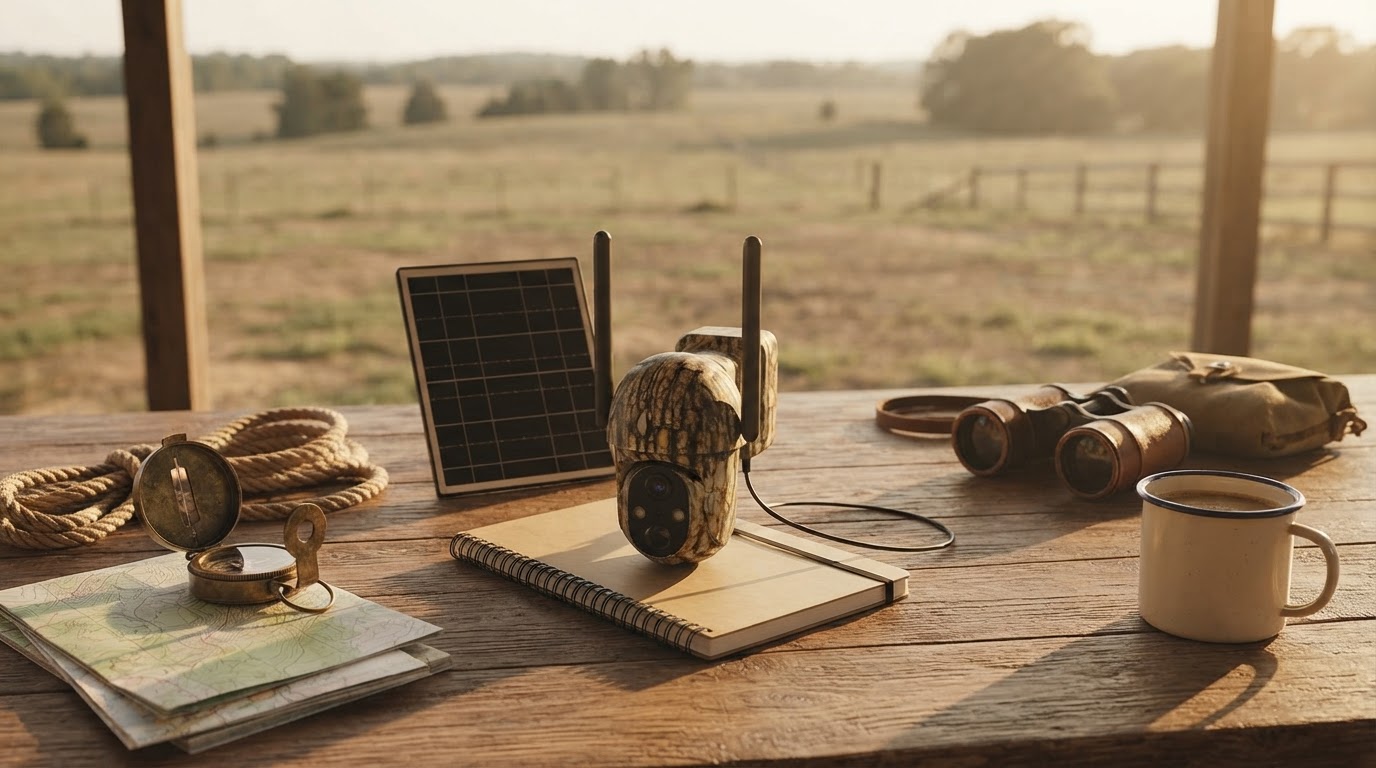
I tested this for one full winter season to see how the Solar Watch Cam handled the low-light conditions of December. What surprised me: even with only four hours of indirect sunlight, the integrated solar panel managed to keep the internal cell at a steady 85% charge. The hardware is designed as an outdoor wireless solar camera, which eliminates the need for trenching cables through rocky soil or around root systems. Because these units are built for solar surveillance camera no wifi scenarios, they rely on cellular connectivity or local storage, which simplifies the setup process significantly. When I first mounted the unit on a cedar post, I was skeptical about the signal strength in a valley, but the internal antenna caught enough signal to send motion alerts reliably. Here's the moment it earned its place: a heavy storm knocked down a limb that would have crushed a wired setup, but the wireless Solar Watch Cam stayed active, capturing the entire event and alerting me to the property damage in real-time. This level of autonomy is essential when you are learning how to secure a remote property without internet. The build quality held up against sustained rain and freezing temperatures without the lens fogging, which is a common failure point in cheaper consumer-grade hardware. It provides a level of persistence that DIY solar spotlight cam setups often struggle to match because the components are tuned to work together rather than being cobbled together from disparate parts.
A Framework for Off-Grid Deployment
Deploying a system on a remote site requires a different tactical approach than a suburban backyard. You have to think about sun paths, mounting heights, and the specific needs of your structures. If you are looking for off grid cabin security ideas, you should focus on overlapping fields of view that cover both the structure and the approach trails. What I'd do differently next time is mount the units slightly higher—around ten feet—to avoid curious wildlife and to get better clearance for the solar panels above the undergrowth. When selecting your hardware, use this checklist to ensure the system can survive the environment:
- Verify the solar panel wattage is sufficient for the local climate's average peak sun hours.
- Ensure the unit supports local SD card recording as a fail-safe for cellular outages.
- Select a mounting location that offers a clear southern exposure for maximum charging efficiency.
- Test the motion sensitivity levels to prevent false triggers from swaying branches.
- Confirm the weatherproofing rating is at least IP65 to handle driving rain and snow.