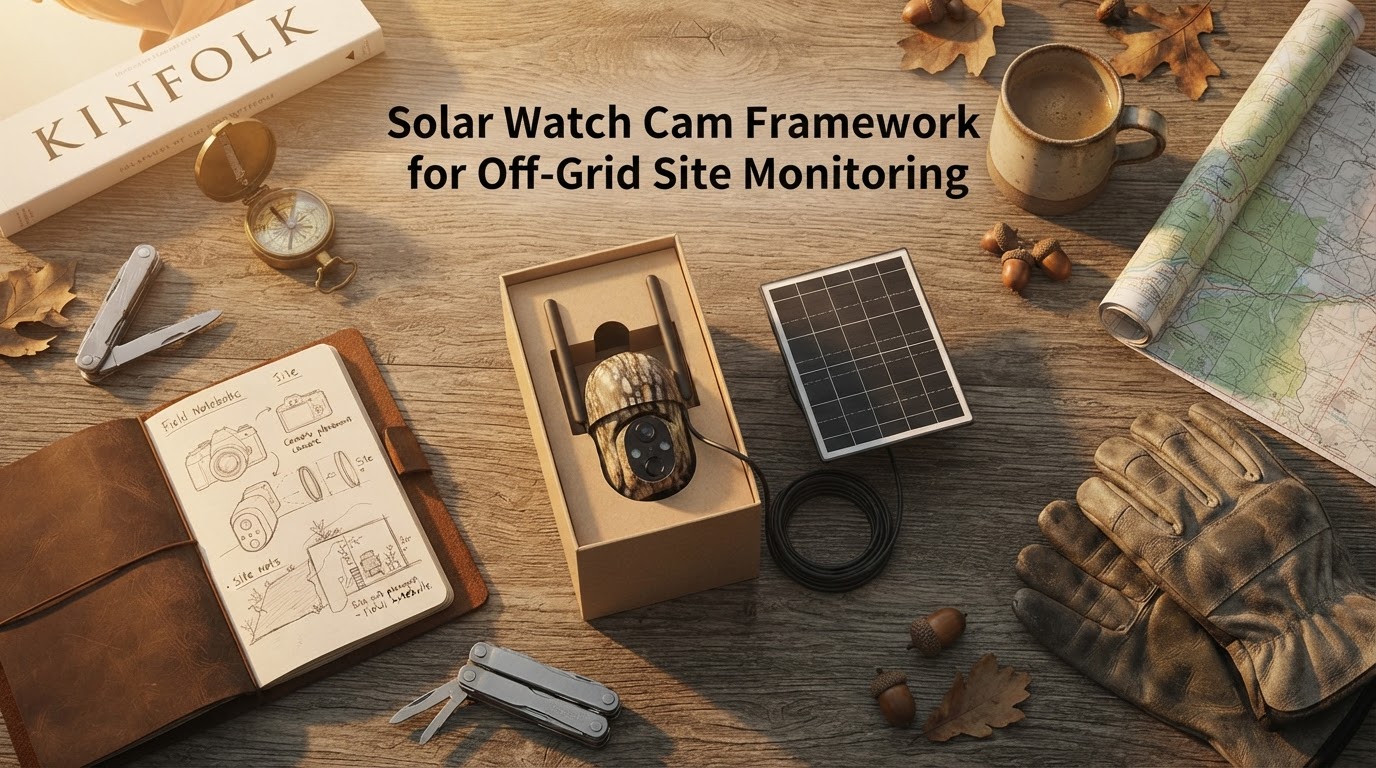
Solar Watch Cam Framework for Off-Grid Site Monitoring
 Priya RamanSenior Analyst
August 11, 2026 — The rising demand for autonomous security in remote locations has placed the Solar Watch Cam at the center of modern off-grid site monitoring strategies.
Professional site management requires a departure from consumer-grade WiFi expectations toward a resilient, self-sustaining infrastructure. According to insights from Milesight, 4G solar-powered security cameras offer reliable monitoring in off-grid areas without WiFi or power, making them the primary choice for farms and construction sites. The integration of high-efficiency photovoltaic panels with cellular modems allows for a complete decoupling from local utilities, provided the hardware is selected through a rigorous evaluative framework.
The Three-Axis Reliability Model
When evaluating hardware for remote deployment, two axes matter here: energy autonomy and data persistence. Think of it as a matrix of power availability versus communication stability. The Solar Watch Cam addresses these dimensions by utilizing high-capacity lithium-ion batteries paired with integrated 4G LTE modules. For a standard off-grid installation, the hardware must sustain an IP66 or IP67 weather resistance rating to survive environmental exposure without manual intervention. The energy axis is defined by the solar panel's conversion efficiency and the camera's standby power consumption. In remote environments, the system must remain operational during extended periods of low solar irradiance, often necessitating a battery buffer that can support five to seven days of operation without direct sunlight. The data axis focuses on signal penetration; while a solar surveillance camera no wifi eliminates the need for local routers, it requires a high-gain antenna to maintain a connection to cellular towers. Once you see it this way, the selection process shifts from comparing megapixels to comparing uptime reliability. For those securing remote properties with Solar Watch Cam, the priority is a system that reports its own health metrics. Real-world applications, such as those documented by PowerStack in the Royal National Park, demonstrate that off-grid solar systems provide the essential energy for wireless communications in areas where traditional cabling is impossible. The decision rule: prioritize high-gain 4G connectivity and IP66-rated housing over high-bitrate streaming to ensure the system remains reachable during critical events.
Expert tip: When deploying in high-latitude regions, tilt the solar panel to an angle equal to your latitude plus 15 degrees in winter to maximize solar harvest and prevent snow accumulation from blocking the cells.
Effective off-grid monitoring often requires a portable solar surveillance cam for temporary sites, ensuring that the solar watch camera for remote properties can be redeployed as project needs evolve. Maintaining visibility in locations without infrastructure is no longer a logistical hurdle but a matter of selecting hardware designed for autonomy.
Sources
- Off-grid solar system for park monitoring - PowerStack
- How to remotely monitor off-grid solar camera battery ...
- Off-Grid Solar Security Systems