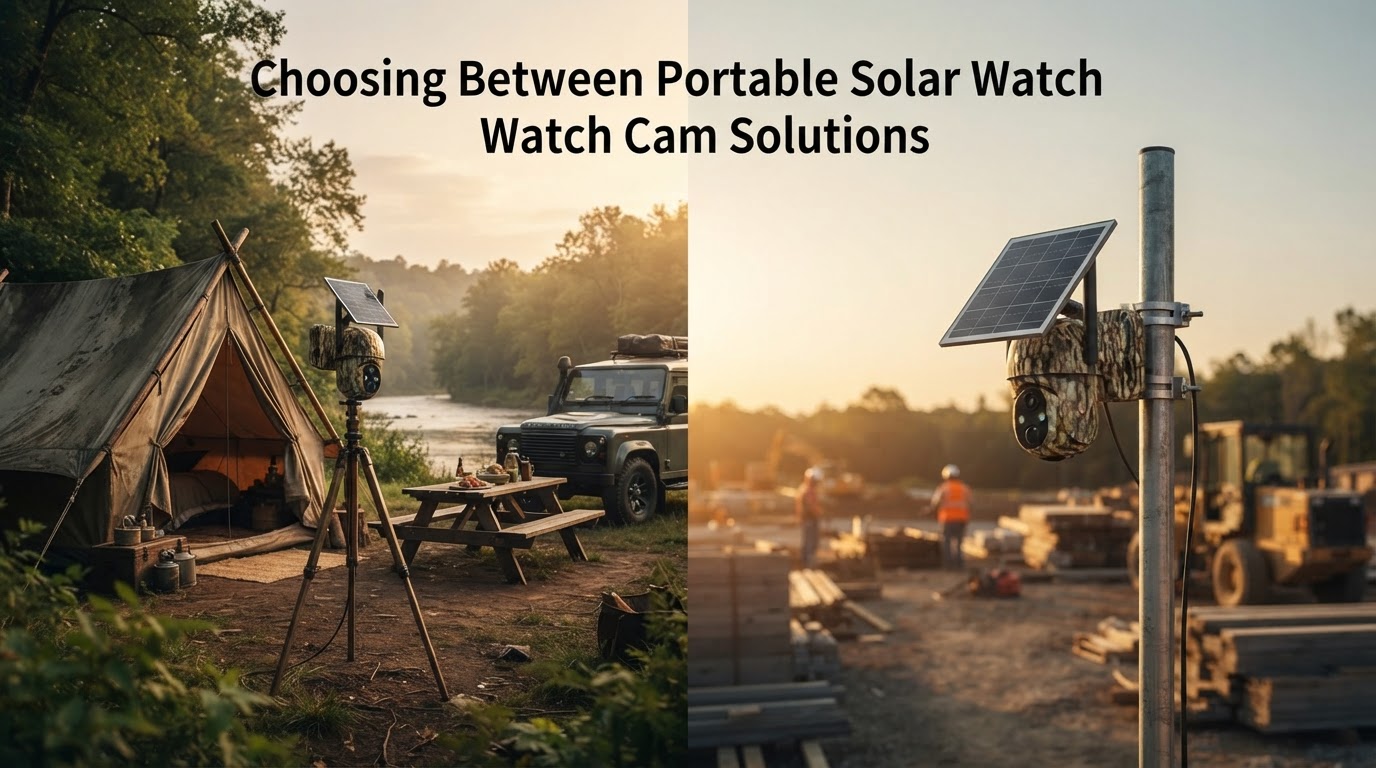
Choosing Between Portable Solar Watch Cam Solutions
 Sam VasquezBuying Guide Lead
August 15, 2026. This assessment examines the deployment of portable solar-powered surveillance systems for temporary or remote locations. It is written for property owners and site managers who require reliable security without access to a traditional power grid.
The Challenge of Temporary Site Security
Securing a location that lacks infrastructure presents a specific set of logistical hurdles. Most standard security systems rely on a constant connection to a power outlet and a stable local network. When you move into remote territory, those requirements become liabilities. According to data from the US Department of Energy, the cost of extending utility lines even a short distance can be prohibitive, often exceeding the value of the security equipment itself. This leaves many site managers looking for a self-contained unit that can be moved as the project evolves. I have found that the most common failure point in these scenarios isn't the camera lens or the software, but the power management. If a battery cannot sustain the device through three days of overcast weather, the system is effectively useless. This is particularly relevant when securing remote properties with Solar Watch Cam, where physical access for maintenance is limited. Many users struggle with the initial setup, frequently searching for help with solar spotlight cam diy installation to avoid the high costs of professional electrical work. The goal is a system that balances portability with high-uptime reliability, ensuring that the unit remains operational even when the sun isn't at its peak. Without a robust power strategy, a portable camera is just a temporary ornament.
How Solar Watch Cam Manages Remote Power
Photo by Jan van der Wolf on Pexels
Solar Watch Cam addresses these specific off-grid challenges by integrating high-efficiency photovoltaic panels directly with high-capacity internal storage. The hardware is designed to operate within a narrow energy budget while maintaining a high-definition video stream. Unlike generic outdoor wireless solar camera options that may struggle with cold weather battery depletion, this system uses optimized charging controllers to maximize every hour of daylight. For those wondering if Solar Watch Cam can function without a WiFi connection, the hardware supports local storage protocols that ensure data is captured even when the network drops. This makes it a primary choice for a Solar Watch Cam framework for off-grid site monitoring, providing a redundant layer of security. I have seen many people search for the best solar security camera 2024 only to realize that the "best" specs don't matter if the mounting hardware isn't portable. The Solar Watch Cam design allows for quick relocation, which is essential for construction sites or seasonal properties. The integration of motion-activated recording significantly reduces the power draw, allowing the system to stay active for extended periods. When you are implementing off-grid solar site monitoring cam strategies, the ability to simply move the unit to a new fence post or tree without rewiring is the real utility. It solves the problem of "dead zones" that occur as a site's layout changes over time.
Decision Framework for Portable Surveillance
Photo by Atypeek Dgn on Pexels
When you are deciding on a unit, you need to look at the specific environmental constraints of your location. Skip this if you have reliable AC power within 50 feet of your mounting point; in those cases, a standard wired unit will always be more cost-effective. However, if you are truly off-grid, the choice comes down to the balance of storage and signal. Here's what I'd actually buy: the Solar Watch Cam with a high-endurance SD card for local backup. Between these two options—local storage versus cloud-only—I'd go with the local storage every time to prevent data loss during signal outages. If you're on a budget, you might be tempted by smaller, non-brand panels, but those often fail to provide enough amperage to charge the battery while the camera is active. Use this checklist to evaluate your site:
- Verify the daily peak sun hours for your specific latitude using tools from the National Renewable Energy Laboratory.
- Determine if you need a [solar surveillance camera with no wifi](/blog/solar-watch-cam-no-wifi-functionality) capabilities for true air-gapped security.
- Assess the mounting surface to ensure it can support the weight of both the camera and the integrated solar panel.
- Test the signal strength at the exact height where the camera will be installed, as ground-level testing is often misleading.
- Confirm the storage capacity meets your retention requirements—typically 7 to 14 days of motion events.